UVIC SUMMERGRADUATEBUSINESS STUDIES (SGBS).
Module 1: Cross-Cultural Management study abroad experience
IBA Corporate Strategic Management Course, Management Programme Major.
W.H.
If you are considering participating in the UVIC SUMMER GRADUATE BUSINESS STUDIES (SGBS), please refer to Mr. N’s experience report for general preparation and accommodation, etc., as opposed to my summary, where I focused on writing my experience with programme and the lectures.You can get a good idea of the program by reading both reports.
SGBS Module 1 is a discussion-based active learning programme on the essentials of cross-cultural management (CCM), which is necessary for global managers in the future, In order to enhance this learning, and due to the fact that the programme is located at the beginning of Modules 2 and 3, it was designed in the form of activities with classmates in the morning and lectures in the afternoon. Therefore, we felt that on Tuesday, the second day of the programme, we became much closer psychologically to our other classmates, and from then on we experienced Cross-Culturalism through collaborative work with our classmates.
I myself am in my late fifties, so I was concerned about how the generational differences between me and my participating classmates would affect our communication. In the end, however, I believe that the fact that I am Japanese, a senior businessperson, etc., made a positive contribution to the class by providing a minority perspective. I feel that the study abroad experience went by very quickly, which tells me that it was a fulfilling experience.
In summary, I feel that SGBS Module 1 will not only provide new knowledge input to IBA students as they continue their studies towards an MBA, but the experience of studying abroad based on dormitory life at the UVIC campus in Victoria, Canada, will also provide them with a unique intellectual excitement and an invaluable asset in the form of foreign alumni. I would like to encourage all IBAs to take the plunge into this wonderful programme.
[Contents of participating classes]
I attended with my IBA colleague N.
There were 20 members in the class: all but two, Mr N and myself, were students at the same business school in Bonn, Germany, where they were studying for their MBAs. They all work for a bank and this SGBS is a mandatory subject for them.
[Schedule]
The lecture schedule is as per the schedule above.
The CCM was the first module of the SGBS and included activities that allowed participants to experience not only the UVIC campus, but also the city of Victoria and Victoria’s natural environment. I was completely charmed by Victoria during the beautiful flower season, with clear skies and sunny weather, and through these activities I was completely fascinated by Victoria.
[Activity]
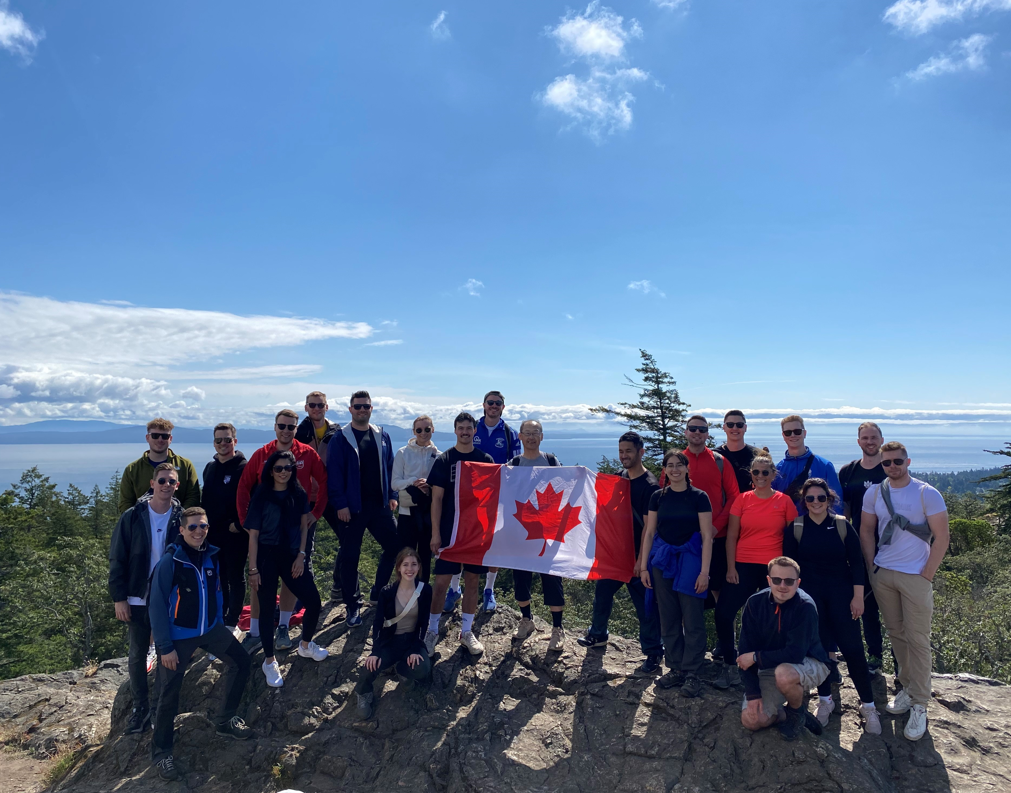
・< 18th Tuesday, a.m. >Mountain hiking in the suburbs (photos)
・< 20th Thursday, a.m.> Tour of Victoria’s harbour Inner Harbour (lecture by the Harbour Authority)
・< 21st Friday, a.m.> Chinatown to Victoria State House (guided tour)
・< 25th Tuesday, after the lecture> Whale watching tour (optional).
[Lecture content]
The CCM began with a meeting over breakfast on the first day, Monday. A catered snack was taken, followed by a campus tour led by UVIC staff.
The lectures then began in the afternoon. The lectures were basically divided into two three-hour sessions from 1pm to 4pm each day.
The first half of the course is a powerful MBA lecture-style class by the instructor in charge, Dr Sang H. Nam.
Dr Sang sat down at the desks of the students, who were seated in a U-shape with mugs in their hands, and spoke to them with increasing enthusiasm. Dr Sang would then ask questions to the students in an over-acting, intonated tone, and after receiving the students’ answers in the affirmative, he would ask more questions to deepen the learning steps in multiple layers. The classroom was filled with a sense of tension and enthusiasm, and I was thrilled by this lively lecture, which was a series of moments of intellectual excitement. The students were so focused that they didn’t want to miss a single word from Dr Sang, and I was among them in a comfortable state of concentration. This is what an MBA is all about!
Nevertheless, while I was happy that I had come to this amazing place, I couldn’t help but wonder if I would be able to keep up with all this hot English language teaching. And my fears were not unfounded, as Dr Sang would prepare video material for each class, one day a documentary-like case study film, the next a film about culture clashes, and so on, so I had to make sure I understood the story. There were no subtitles, so it was all about concentrating and listening. In addition to this, Dr Sang also prepared handouts separately from the preparatory material, and each class discussion in the lecture was skilfully led so that each class discussion was a team ‘game’ using the handouts. It was the first half of such a fight, all about understanding and communicating in English in a no-preparation environment.
The second half was a unique class discussion called the Learning Cell.
The Learning Cell (LC) is where Dr Sang at-randomly assigns five students to four groups on the day of the lecture, where they summarize the key lessons and points from the discussion and share them with the whole class after the discussion is over What makes the LC unique is that the best answer (BA) and Best Question (BQ) choices (full name and a brief explanation of why the choice was made). As it was assumed that students would have to be selected for these BAs and BQs to gain the grade count points considered necessary for completion, the students were structured to participate in the class discussion, eagerly and desperately trying to become a BA/BQ. This was an insurmountable hurdle for myself as a non-native English speaker. However, as a result, the whole class was able to clear the hurdle together in a bonding experience with their classmates.
The final project work involved teams creating and presenting a 10-minute video as a result of their CCM studies. The project activity focused on each team perfecting their video for the competition, so the activity was far beyond the classroom hours and continued after returning to the dormitories. The sun was always high in Victoria in the early summer, and the long evenings made the collaboration with teammates unforgettable. The video was a process that began with teammates discussing how they wanted to visualize the CCM’s achievements, and then involved creating a scenario, shooting the video, editing the video and brushing up on the video to make it look better, but each process required a lot of communication with teammates. The quality of the video was enhanced in the process.
…various assignments were sometimes informed the day before the lecture.
[Other]
I am in a department that conducts overseas business trips and my English proficiency is TOEIC 775, but the reality is that I had considerable difficulty in expressing my intentions in English in a timely manner in class discussions such as the LC mentioned above. In class discussions, each member is fighting for a BA and a BQ with limited time, so it was difficult for me to lead the discussion or even participate in it. Often, I was unable to smoothly read and understand the English text of the handout distributed on the day of the lecture, and as a result, I was sometimes unable to complete the planning of negotiation strategies during the negotiation role-playing (negotiation simulation game) in English.
In the midst of all this, I still felt that I was in the midst of a cross-border group of classmates who supported each other, and there was no isolation or loneliness. I was moved by the fact that I was in the midst of this borderless bond of teamwork, where all my classmates were trying to improve each other and achieve goals together, and I accept this as the greatest asset of learning cross-cultural management that I gained during this study abroad.
I would like to avoid describing the lecture content itself or the classroom scene in detail. I want everyone to participate without preconceptions, and I think it would be a shame to allow a sense of deja vu to set in. Before my trip, I did my best not to check the UVIC website, expecting to have a fresh experience there.
In the dormitory room of a German student, we watched a live broadcast of the Germany-Hungary match, a big football tournament in which the national teams of each European country played each other. We all stood shoulder to shoulder, sang the German national anthem and celebrated together, which was one of the highlights of my study abroad experience.
German students went out to an Irish pub in Victoria on Sunday to watch a live broadcast of the ‘Germany vs Switzerland’ match! I was invited to join them with Mr N. The match turned out to be a miracle, so to speak, with Germany scoring towards the end of the second half, resulting in a 1-1 draw. This meant that Germany would advance to the final tournament, and we shared the joy of the victory celebration. When Mr N and I were about to leave after the match, we decided to stay and talk. The German students also told us how hard they had been facing the new challenge of studying abroad and how happy they were to have become friends in this way, and we felt the significance of people-to-people exchanges across national borders.
[Finally]
Since I had the ambition to complete my basic research on the subject in the autumn intensive in my first year and to do my research on the subject in the first and second half of the spring semester of my second year, it was expected that the SGBS would take place in the second half of the spring semester of my second year, when I was in the middle of doing my research on the subject. Therefore, it was very important for me to find a way to balance the SGBS with my assigned research.
I confirmed several times in advance with the IBA office that the 2024 SGBSModule1 was scheduled to take place in mid-June, and then backcasted and planned my coursework for each quarter of the first year. Specifically, I completed all of the required courses in the first year, took the Issue Study Basis in the intensive course in the autumn semester of the first year (February), and only took Issue Study in the spring semester of the second year, so that I could concentrate on Issue Study and SGBS Since SGBS is an advanced course credit, I was not aware that SGBS was also appealed to me as it would be a credit required for completion of the course.
As a result, I was able to combine my research project with the SGBS by receiving permission to participate in the SGBS from my supervisor, as well as by participating in the research project seminar via Zoom online from UVIC. In retrospect, IBA is very cool and excellent in this respect, as the business style of modern global managers, who communicate online across national borders, has enabled me to combine my research seminar with the SGBS. In fact, Mr N and I participated in a Zoom online seminar on Saturday afternoon in Japan from after 9pm to midnight after Friday lectures in Canada, but we were able to participate in the seminar smoothly by using UVIC’s WIFI. Looking back, one of the strengths of the IBA is also the ability to carry out research assignments online in this way, and I am grateful for the advanced learning style of the IBA.
As for my assigned research, I consulted with my primary supervisor to ensure that I had completed my research and had the outline of my dissertation ready before my SGBS study abroad, and then I travelled to Canada. I think this was very important for me to be able to balance my commitment to my assigned research with my commitment to the SGBS. I would like to encourage everyone who reads this report to go to the SGBS, which is a wonderful, enriching and inspiring experience, and would therefore recommend that you consult your supervisor as soon as possible if you are planning to do a research project in the spring semester of your second year. The Associate Dean who interviewed me and N-san not only gave us permission to participate in the SGBS, but also gave us friendly advice on what to expect in class discussions. In this way, the IBA professors are very supportive of our study at UVIC and we can be confident that we will be able to go there with confidence.
From April until before the trip in June, for example, setting up UVIC’s learning system for SGBS, booking travel flights, online travel preparation meetings with the SGBS office and making arrangements for dormitories (N and I made our own dormitory arrangements before SGBS started in order to balance our research assignments), There is intermittent preparation work. Since the majority of the work will be done in English, I think it is best to regard this as the beginning of your study abroad experience. If you have made early arrangements for research assignments so that you can concentrate on that as well, I think you will also enjoy the preparation for your study abroad.
[Acknowledgements]
Last but not least, I would like to thank my IBA colleague N-san from the bottom of my heart. It was only because of her constant support that I was able to have such a tough and exciting SGBS in a “completely away from home” environment, so to speak. I would like to take this opportunity to express my deepest gratitude.