UVIC SUMMER GRADUATE BUSINESS STUDIES (SGBS)
Module 1: Cross-Cultural Management Study Abroad Experience
IBA Corporate Strategic Management Course, Management Programme Major.
N
For more detailed information on the classes, please see IBA W.H.’s experience. I will focus on what I think you may be concerned about when you participate in the course.
[Regarding time differences]
This is 16 hours behind Japan. UVIC classes are from 09:00 AM to 04:00 PM Canadian time. In Japan time, this is AM01:00~ until 08:00. So IBA’s weekday classes are 18:30~ (from AM02:30 Canadian time), but you can still attend classes if you get some sleep after class. In terms of time, it is not impossible to take classes on Saturdays and Sundays.
[Whether it is possible to run parallel to IBA classes]
You can take this course if you are prepared to work hard during your study abroad. In my case, I was in my second year and was parallel to my project research, so I only took the project research for this quarter and was given permission to participate in the project research remotely. However, you should be prepared for a certain amount of hard work in the UVIC classes as you need to prepare for the next day every day.
[On learning]
The content of the lessons is also very interesting. Although the lessons focus on country-by-country comparisons, the learning in this course provides insights that can be applied to the generation gap and regional gap in Japan. The students also learn from the experience of living and discussing together with people from different cultures. The teachers themselves have lived in many different cultural environments and will be able to share their stories with you. I believe that this makes the course beneficial for everyone.
[On accommodation costs]
Those who participated only in Module 1, which we did, are provided with a guest card (a card that can be used in shops, canteens, etc.) worth USD 150. This is not enough to live on for about 10 days. A coffee and burrito for breakfast costs about $10. Lunch is about $15 and at night you should expect to pay about $20. In our case, almost everyone participated in the optional activities. We also go downtown on Saturdays and Sundays. For these reasons, I think you should expect to spend about $700 for living expenses.
[On English language skills]
The class material is basically in a style where there is very little text and photos are displayed to share findings. Also, discussions occur basically every day, and there are occasions when the teacher will ask you to speak. Therefore, it is desirable to be able to listen to some extent and express your own opinion, even if it is simple. It is difficult to set a standard for TOEIC because it includes speaking ability, but 600 points, which is considered the application standard, is quite tough. Therefore, a score of at least 800 is desirable. On the day of the course, you may be given a document out of the blue and have a discussion based on the contents of the document. It is quite difficult because you cannot prepare in advance. If you are worried about your English, it will be much easier if you have Google Lens installed so that you can translate the documents as soon as possible.
[On the level of difficulty of the lessons]
Basically, the focus is on learning about and discussing different cultures. Therefore, the level of difficulty is quite low, as there is no discussion where there is a right answer. You will also be given a topic to consider in advance for the next day. It usually takes about 30 minutes, so it is not that burdensome. Also, basically, the mornings are devoted to downtown inspections, etc., and lectures are only held in the afternoons for three hours, from 13:00 to 16:00. This means that classes finish at 16:00 and you have enough time to prepare for the next day and beyond. Also, on the last day, there is no test, but rather a presentation of a video that shows different cultures. The level of difficulty is not a concern, as you will learn while having fun.
[Reference books, etc.]
It is distributed digitally a few days before Module 1 starts. It is advisable to read the relevant sections well in advance so that you can understand the flow of the class and speak up during discussions. We recommend that you focus on the key points as you have a limited amount of time to read.
[On the living environment]
It is chilly in the morning and a little hot during the day. If you have slightly thicker swearshirts, you will be fine in the mornings. You will also live together in a dormitory for four people in an environment with lots of nature. I participated with my colleague W and left only in Module 1, but the other participants were allocated a dormitory room with just W and I in a room for four because we were going to participate in all modules. So, essentially, I get the opportunity to communicate with people from other countries not only in the classroom but also in the dormitory. It is always a good environment, although it is inconvenient because there is a lot of nature and convenience stores and supermarkets close at 20:00. There is also an unlimited bus ticket for $5 per day. This is very useful when going downtown or sightseeing. I think the security situation is quite good. I often see women shopping or jogging alone. Also, it is still light at around 22:00, so even if a woman goes out alone, she should not feel unsafe unless it is very late.
[If you’re not sure whether to join]
I would recommend taking part. Perhaps you enjoyed interacting with people from backgrounds you would not normally associate with when you first enrolled at IBA. UVIC’s study-abroad programme allows you to experience this again, but in a different country. It is natural to be hesitant because of various barriers, such as the parallel with IBA classes and the English language. However, by taking the plunge, I think it is rare to have such a wonderful opportunity to experience such a wonderful experience even after you have entered the workforce. Cross-Cultural Management also focuses on the uniqueness of the Japanese people. Through this class, you will be able to re-recognize what it is like to be Japanese and how you compare to the rest of the world.
[Acknowledgements]
Last but not least, I would like to thank my IBA colleague W from the bottom of my heart. It was a real pleasure to share many insights with you over local beer and local wine every day. And thank you very much for acting as a bridge between us and everyone in Germany.
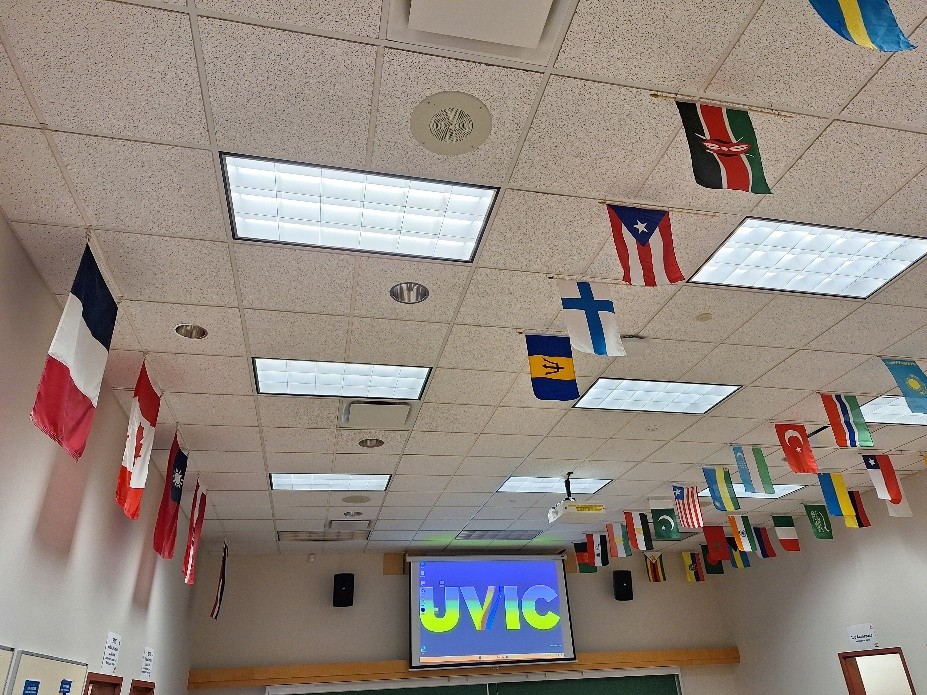
Flags from all over the world hanging in the classrooms are a true representation of Cross-Cultural Management.